

The 2026 IoT security mess
The Internet of Things is a mess. Every new connected gadget is another door left unlocked for hackers. We aren't just seeing more attacks; we're seeing meaner ones. In 2025, successful breaches jumped 60%, and 2026 is on track to be worse. Most of these hits happen because companies ship hardware with lazy security and never bother to patch it later.
The risks aren’t theoretical. Reports from 2025 showed a 60% increase in successful IoT-based attacks compared to the previous year, and that trend is continuing into 2026. A significant portion of these attacks exploit known vulnerabilities that remain unpatched due to a lack of ongoing security maintenance. This is particularly concerning in critical infrastructure where the consequences of a successful breach can be catastrophic.
The National Institute of Standards and Technology (NIST) Special Publication 800-213 provides essential guidance for federal agencies, but its principles are applicable to any organization deploying IoT devices. It emphasizes the need for a lifecycle approach to security, from device acquisition to decommissioning. While a solid framework, simply having the guidance isn’t enough. Consistent implementation and vigilant monitoring are crucial.
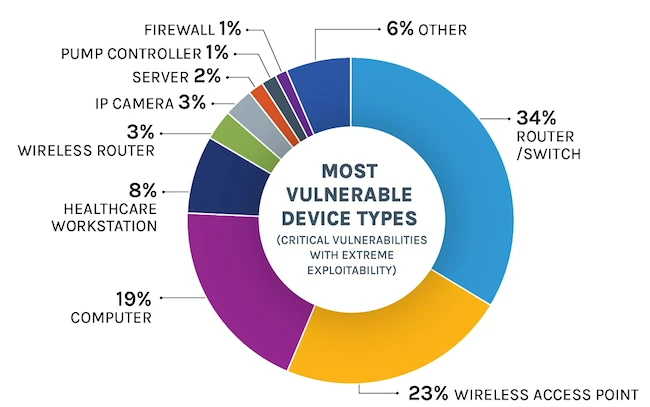
Why your smart home is wide open
Smart home devices represent a particularly vulnerable segment of the IoT landscape. Devices like security cameras, thermostats, smart locks, and voice assistants are often designed with convenience in mind, frequently at the expense of security. Many still ship with easily guessable default passwords, and a surprising number of users never bother to change them. This is a fundamental flaw that attackers readily exploit.
Unencrypted communication is another common problem. Many devices transmit data over unsecure Wi-Fi networks, making it easy for attackers to intercept sensitive information like login credentials or video feeds. Recent breaches, such as the 2025 incident involving a major smart camera manufacturer, exposed the personal data of millions of users due to a lack of end-to-end encryption. These breaches highlighted just how easily these devices can be compromised.
If a hacker gets into your smart fridge, they aren't there for the groceries. They use it as a bridge to your laptop or your bank accounts. I've seen home networks where a single cheap lightbulb gave up the password for the entire house. You have to split your network so your 'smart' junk can't talk to your actual computer.
The lack of consistent security updates is a persistent issue. Many manufacturers abandon support for older devices, leaving them vulnerable to newly discovered exploits. Users are often left with the choice of continuing to use an insecure device or replacing it entirely. This creates a significant security risk, especially as devices age and become increasingly targeted.
- Swap out default passwords the second you unbox the device.
- Enable two-factor authentication whenever possible.
- Keep device firmware up to date.
- Segment your home network to isolate IoT devices.
🚀 @SecurityWeek reports a significant rise in IoT security vulnerabilities, with over 50% of connected devices at risk, making it a major concern for consumers and enterprises, and a key challenge for the future of IoT.
— OWL🦉 (@ankitsi9gh) April 7, 2026
Industrial hardware is a bigger target
The Industrial Internet of Things (IIoT) presents a different, and arguably more dangerous, set of security challenges. These devices are used in critical infrastructure sectors like power grids, manufacturing plants, and water treatment facilities. Unlike a compromised smart thermostat, a successful attack on an IIoT system can have real-world physical consequences.
Securing legacy systems is a major hurdle. Many industrial facilities rely on aging equipment that was not designed with cybersecurity in mind. Retrofitting these systems with modern security controls can be difficult and expensive. The need for robust authentication and access control is paramount, but often lacking in these environments.
The potential for state-sponsored attacks targeting IIoT systems is a growing concern. Nation-state actors are increasingly interested in disrupting critical infrastructure, and IIoT devices provide a potential avenue for doing so. Attacks could range from sabotage to data theft to ransomware, all with potentially devastating consequences. Fortinet research points to increasing targeted attacks on industrial control systems.
The convergence of IT and OT (Operational Technology) networks also introduces new risks. Traditionally, these networks were isolated from each other, but the increasing adoption of IIoT is blurring those boundaries. This creates new pathways for attackers to gain access to critical systems.
Vulnerable SDKs and Supply Chain Issues
Many IoT devices rely on third-party Software Development Kits (SDKs) to provide core functionality. While these SDKs can accelerate development, they also introduce potential security vulnerabilities. If an SDK contains a flaw, all devices that use it are potentially at risk. The complexity of modern software makes it difficult to thoroughly vet every component.
The IoT supply chain is another significant source of risk. Devices are often assembled from components sourced from multiple vendors, making it challenging to verify the security of the entire chain. A compromised component can introduce vulnerabilities into a device, even if the manufacturer themselves has implemented robust security measures. This is a particular concern for devices manufactured in countries with lax security standards.
The lack of transparency in the supply chain further exacerbates the problem. Manufacturers often lack visibility into the security practices of their suppliers, making it difficult to assess the risks. Addressing these vulnerabilities requires a collaborative effort across the entire IoT ecosystem.
- Demand transparency from your suppliers.
- Audit every component before it hits the assembly line.
- Implement a robust vulnerability management program.
- Prioritize suppliers with strong security practices.
Supply Chain Security Approach Comparison - May 2026
| Approach | Cost | Complexity | Effectiveness | Implementation Time |
|---|---|---|---|---|
| Vendor Vetting | Moderate | Moderate | Moderate | Ongoing |
| Software Bill of Materials (SBOM) | Low to Moderate | Moderate | Moderate to High | Initial effort + Ongoing Updates |
| Regular Security Audits | High | High | High | Periodic - typically quarterly or annually |
| Runtime Application Self-Protection (RASP) | Moderate to High | High | High | Moderate - requires integration with existing systems |
| Vendor Vetting & SBOM | Moderate to High | High | High | Initial effort + Ongoing |
| Regular Audits & RASP | Very High | Very High | Very High | Ongoing and significant |
| SBOM & RASP | Moderate | High | High | Moderate - requires integration and ongoing SBOM management |
Illustrative comparison based on the article research brief. Verify current pricing, limits, and product details in the official docs before relying on it.
Penetration Testing: Finding the Gaps
Penetration testing is a critical step in identifying and exploiting IoT vulnerabilities. Unlike vulnerability scanning, which simply identifies potential weaknesses, penetration testing actively attempts to compromise systems. This provides a more realistic assessment of an organization’s security posture.
There are two main approaches to penetration testing: black-box testing and white-box testing. In black-box testing, the tester has no prior knowledge of the system. In white-box testing, the tester has access to source code and other internal information. Both approaches have their advantages and disadvantages.
IoT penetration testing requires specialized expertise. Testers need to understand the unique security challenges of IoT devices, including their limited processing power, constrained memory, and diverse communication protocols. Tools like Burp Suite and Metasploit can be adapted for IoT testing, but manual analysis is often essential.
No comments yet. Be the first to share your thoughts!