
The shift toward ai pen testing
Cyber attacks are getting faster and harder to catch. Standard firewalls don't cut it anymore. We've relied on manual penetration testing for years to find the holes, but humans can't keep up with the sheer volume of new code being shipped every day.
A significant hurdle is the growing skills gap in cybersecurity. Qualified pen testers are in high demand, and the competition for talent is fierce. Even for organizations that can attract skilled professionals, keeping up with the pace of technological change is difficult. This is where artificial intelligence steps in, not as a replacement for human expertise, but as a force multiplier.
The narrative isn’t about AI replacing pen testers; it’s about fundamentally changing how they work. AI-powered tools can automate repetitive tasks, analyze vast amounts of data, and identify vulnerabilities that might be missed by human analysts. This allows pen testers to focus on more complex, creative problem-solving, and ultimately, to deliver more effective security assessments. This isn’t hype, it’s a necessary evolution in how we approach cybersecurity.
The tools emerging now aren’t simply automating existing processes; they’re enabling entirely new approaches to vulnerability discovery and risk management. We’re seeing a shift towards continuous security testing, integrated directly into the software development lifecycle. This proactive stance is crucial in a world where attackers are constantly probing for weaknesses.
Five tools changing the workflow
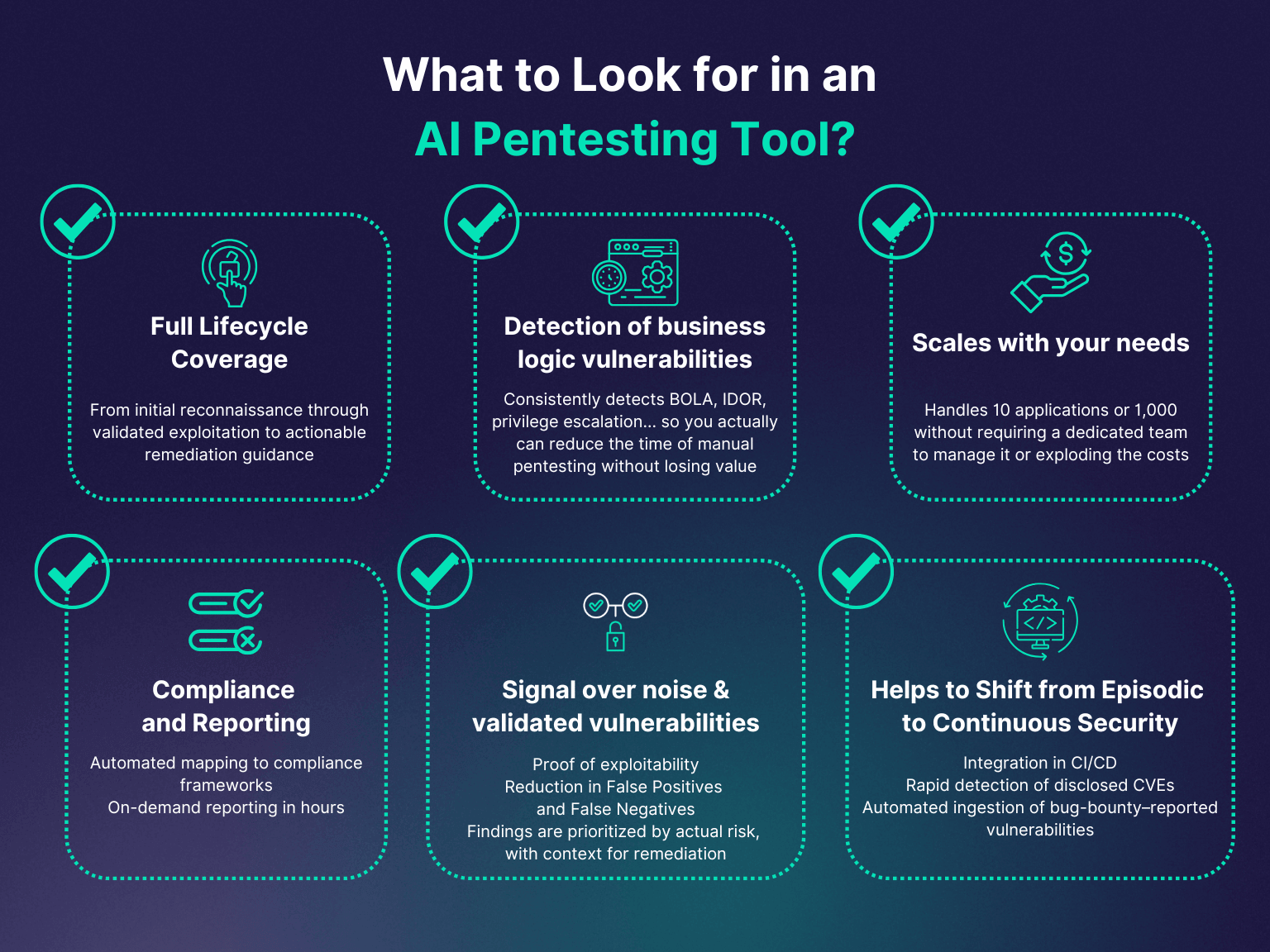
By 2026, a few platforms have moved beyond basic scanning. They use machine learning to actually look at how an app behaves rather than just checking a list of known bugs. The tech moves fast, but these five are the ones I'm watching right now.
Here are five tools that are expected to be game-changers:
Detectify: This platform uses a crowd-sourced approach, combining the knowledge of security researchers with AI-powered scanning to identify a wide range of vulnerabilities.
Probely: Focused on automating the entire pen testing workflow, Probely aims to reduce manual effort and accelerate the identification of security flaws.
Invicti (formerly Netsparker): Invicti leverages AI to accurately identify and validate vulnerabilities, minimizing false positives and providing actionable insights.
Cobalt.io: Cobalt.io offers a "Pen Testing as Code" approach, integrating security testing directly into CI/CD pipelines.
StackHawk: Similar to Cobalt.io, StackHawk focuses on integrating security into the development process, enabling developers to identify and fix vulnerabilities early on.
Detectify and crowd-sourced hunting
Detectify distinguishes itself through its unique crowd-sourced approach. The company leverages a network of security researchers who contribute their expertise to identify new vulnerabilities and attack vectors. This knowledge is then integrated into the platform’s AI engine, enhancing its ability to detect threats. The AI learns from the researchers' findings and applies that knowledge to automated scans.
Detectify excels at identifying a broad spectrum of vulnerabilities, including cross-site scripting (XSS), SQL injection, and server-side request forgery (SSRF). Its ability to detect vulnerabilities in complex web applications is particularly noteworthy. The platform also integrates with popular DevOps tools, allowing security testing to be incorporated into the CI/CD pipeline.
One area where Detectify has focused its efforts is reducing false positives. Automated scanning tools often generate a high number of false alarms, which can overwhelm security teams. Detectify’s AI algorithms are designed to filter out these false positives, ensuring that analysts focus on genuine threats. However, like all automated tools, some level of manual verification is still recommended.
Probely and invicti automation
Both Probely and Invicti are focused on expanding the reach of automation in penetration testing. Probely aims to automate the entire pen testing workflow, from reconnaissance and scanning to exploitation and reporting. This end-to-end automation significantly reduces the amount of manual effort required, allowing security teams to test more frequently and thoroughly.
Invicti takes a slightly different approach, focusing on accurately identifying and validating vulnerabilities. Its AI engine is designed to minimize false positives, providing security teams with actionable insights. Invicti's 'Proof-Based Scanning' technology attempts to automatically exploit identified vulnerabilities, confirming their existence and severity.
Probely might be better suited for organizations looking for a comprehensive, fully automated solution, while Invicti could be a good choice for those who prioritize accuracy and minimizing false positives. Both platforms offer robust reporting capabilities, providing detailed information about identified vulnerabilities and their potential impact. Choosing between the two often comes down to specific organizational needs and priorities.
Treating pen testing as code
Cobalt.io and StackHawk both champion a "Pen Testing as Code" approach, integrating security testing directly into the software development lifecycle. This allows developers to identify and fix vulnerabilities early in the process, before they make it into production. Both platforms provide APIs and integrations with CI/CD pipelines, making it easy to automate security testing.
This shift-left approach to security offers significant benefits, including reduced remediation costs and faster release cycles. By identifying vulnerabilities early, developers can address them more efficiently and avoid costly rework later on. However, it also requires a cultural shift within the organization, with developers taking greater responsibility for security.
While these tools streamline the process, they don’t eliminate the need for expertise. Interpreting the results and prioritizing remediation efforts still requires skilled security professionals. These platforms augment the capabilities of pen testers, but they don’t replace them. They facilitate a more collaborative approach, where developers and security teams work together to build more secure applications.
Essential Reading: Deep Dive into AI-Powered Penetration Testing

Develop AI approaches for cybersecurity challenges · Understand AI applications in organizational security · Gain insights into practical AI implementation
This book provides foundational knowledge on applying AI to solve complex cybersecurity problems within an organization.

Learn to break self-learning systems · Develop penetration testing skills using Python · Master machine learning techniques for offensive security
This resource equips readers with the advanced machine learning skills necessary to target and exploit self-learning systems in penetration testing.

Build AI-driven penetration testing agents · Automate complex offensive security workflows · Develop smarter, agentic AI for cybersecurity
This book focuses on creating and deploying AI agents to automate and enhance the sophistication of penetration testing operations.

Explore advanced penetration testing techniques · Understand red teaming methodologies · Gain insights from experienced professionals
This handbook offers advanced techniques and strategies crucial for sophisticated red team operations and penetration testing.

Understand the synergy of AI, automation, and active cyber defense · Explore the future of cybersecurity strategies · Learn about integrated defense mechanisms
This resource delves into the critical intersection of AI, automation, and active cyber defense, outlining a comprehensive approach to modern cybersecurity.
As an Amazon Associate I earn from qualifying purchases. Prices may vary.
Where humans still beat the machines
AI is great at the boring stuff, like checking 10,000 input fields for basic injections. But it's still bad at logic. It doesn't understand that a specific data leak might bankrupt a company while another is just a nuisance. It lacks the intuition I've seen seasoned testers use to chain small, 'low-risk' bugs into a total system compromise.
For example, AI might be able to identify a SQL injection vulnerability, but it may not be able to understand the potential impact of that vulnerability on the business. A human pen tester can consider the sensitivity of the data being accessed and the potential consequences of a successful attack. AI also struggles with novel attack vectors that haven’t been seen before.
AI is best viewed as a tool to augment human pen testers, not replace them. Human oversight and validation are essential to ensure that AI-generated findings are accurate and actionable. Pen testers can use AI-powered tools to automate routine tasks, freeing up their time to focus on more complex investigations and strategic security assessments.

No comments yet. Be the first to share your thoughts!